Thursday, September 30, 2010

Getting Scientific

I think that there is not one kind of Sci-Fi. We categorize any movie that has some sort of beyond belief, scientific element (such as aliens, time travel, crazy mechanical contraptions that do the unbelievable, etc.) as Science Fiction, but I believe that there are two distinctions of Science Fiction: Science Fantasy and Scientific Fiction.
Now, here's how I came to this point. I love just about anything Sci-Fi or Fantasy, but I've always felt lumping movies like E.T. and Jurassic Park together in the same category is a disservice to both of these movies. Now, let's take a look...

E.T. is a movie about an alien that gets stranded on Earth and befriends a boy named Elliot who helps him to return home. Along the journey we learn that E.T. has these magical powers of telekinesis that have no explanation other than they're magic. Where as, Jurassic Park is a movie about a reserve on a remote island in the Pacific where scientists have genetically engineered dinosaurs in a modern day setting, but when the power goes out on the island and the dinosaurs escape their paddocks, chaos ensues in trying to escape.

Now, both are fantastic movies that I love dearly, but the distinction comes in that E.T. works without any explanation of the scientific elements, and Jurassic Park can't work without them. E.T. can make a bike fly, we don't have to know how, we just have to know he can. Where on the flip side, Jurassic Park would not work without that scientific component of how the scientists genetically engineered these dinosaurs, cause otherwise the audience would never be able to suspend disbelief that there are dinosaurs in a modern day setting. Had the moviemaker (Steven Spielberg, on both counts) decided to say E.T. can make a bike fly cause he has this special chromosome in his body that allows him to manipulate matter, or that these scientists just happened upon an island full of dinosaurs, you would not only be stripping away the charm of these respective movies, but ultimately the suspension of disbelief would not be there.

So what is Science Fantasy? Science Fantasy (which is a term I'm coining myself, though I'll never copyright it) is any movie that has a Science Fiction component, like an alien or a time machine, but it is presented more like a Fantasy. Examples of this are E.T., where E.T.'s powers can simply be described as magic; or Star Wars, where the Force is a spiritual entity that enables those highly attuned to use it in mystical ways, and yet the mechanics of the spaceships and blasters are never explained. Other quick and dirty examples, are: Close Encounters of the Third Kind, The Time Machine, and even something like Superman: The Movie.

So what is Scientific Fiction (another term I'm coining, but wont copyright)? Scientific Fiction is any movie that needs that scientific explanation of the Sci-Fi element, whether it be aliens or time travel, in order for that movie to work. Examples of this are Jurassic Park and its genetically engineered dinosaurs, or Back to the Future and the flux capacitor, "That makes time travel possible." Other examples, are: Avatar, District 9, and 2001: A Space Odyssey.

As you can see for yourself, there is a clear distinction. So is it an injustice to simply lump every movie that's ever featured an alien or time travel into Science Fiction? I believe so. While a movie may have an alien featured prominently in its story, it may not be about aliens at all, but rather about the relationship between an odd creature -- that could just as easily have been Bigfoot -- and a little boy, or about a man searching for the spiritual meaning behind these lights he's seeing in the sky. Where as, you watch a movie like Back to the Future and Jurassic Park cause you wanna see how the moviemakers pull off the conventions presented. How does Marty go back in time? How do these modern day scientists come across an island full of dinosars? You have to have a "How" with Scientific Fiction, or else the viewing is damaged.

While I have a personal love for both kinds of Sci-Fi, I have always found myself more partial to Science Fantasy, rather than Scientific Fiction. Maybe it's my own hatred of science, or my own love of the fantastical and the unexplained that makes me like Science Fantasy movies just a teensy bit more, but whatever it is, I don't think you can look at a Science Fiction movie the same way again after giving this a little bit of thought.

Monday, September 27, 2010

Making it in the Film Industry

(This is purely a rant.)

I was recently told I was a bit too optimistic to be hoping for a future in the film industry. Why is it that everyone who has ever had any dealings in the entertainment business go on to tell you how awful it is and how all anyone will ever do is screw you over? I've heard this story time, and time again. Yes, I understand that only a small percentage of wanna-be-directors actually succeed in the ultimate dream of directing features that actually make money, but I have to hold on to that notion that I might just be one of those few, cause if I don't, who else will?

I don't think I'm naive about the entertainment business, but as a person I like to believe in people. Sure, there are a lot of so-called "sharks" out there, but for every "shark" there has to be an opposing force, a "good person". I believe that there are "good people" out there in the movie business, and while there are so many horror stories about people who were doublecrossed and treated wrong, there are nearly just as many stories of people that were actually treated right (by common ethical standards).

It's not always easy to be optimistic. I mean, there are days where I think I'll never make it, and people constantly reminding me that this is such a hard field to break into doesn't help that self esteem. I understand, so no need to constantly try and deplete my ray of optimism as if I've never heard these horror stories before. Movies are what I love, and I've always felt that I was meant to entertain and tell stories in some way, and movies are how I wish to do just that. I know deep down, that if I actually just try and continue to chip away at it, I will make it doing what I love to do, but being constanly reminded how difficult it is to make it just knocks me back down a few pegs.

Friday, September 24, 2010

Differentiating Japanese Space Battles with Teen Wizards

Movies are a universal tie amongst all countries, but the fact is, majority of the movies that make heaps of money across the sea are American made, not products of their own countries. The American studios have a monopoly on the international business of moviemaking. But I'm of the mind that this could all change if foreign studios took greater risks in releasing and marketing their movies in the Americas.

Let's compare two highly anticipated movies coming out this Holiday season, one an American studio production (WB), the other a Japanese studio production (Toho). Harry Potter and the Deathly Hallows-Part 1 is the first half of the two-part finale to the whole Potter franchise, chronicling the final adventures of everyone's favorite teenage wizard.


Where as Space Battleship Yamato is a live-action version of one of the most popular Japanese anime of all-time, about the crew of a space battleship fighting to save humanity from annihilation.


Both are high concept movies that are highly anticipated by the audiences in which will consume them, but after this the differences begin to pile up.

While Yamato may be big in Japan, it wont have a reach outside Asian territories, where as Harry Potter will be big the world over, possibly giving Yamato a run for its money in its home country! All goes back to the almighty dollar, or yen. Potter has a $200 million+ budget, and Yamato only has a budget of 2.2 billion yen ($22 million). With such a hefty budget, Potter will have the money to market overseas, and the money to open in every foreign territory simultaneously, where as Yamato will be lucky to spread to Hong Kong cinemas by the end of this year. Now, both movies are high budget efforts from their respective countries, but isn't it sad that a $22 million budget is considered high in Japan?

I'll be honest, I wanna see both of these movies. I love Harry Potter and will be there at midnight, but I also think Space Battleship Yamato looks like a fantastic science fiction offering, and I think many other Americans might actually find it worth watching as well. Problem is, Toho doesn't have the money of WB. Reason is a combination of population and American snobbery. First, Japan's population is not as large as that of the U.S. On top of that, most Japanese-made movies don't make it as far as the Americas cause most Americans don't want to watch a subtitled movie, no matter how commercial its material may be. Thus, Japanese movies don't have the large international box office receipts that American movies swim in. What would it take to even the playing field?

If more foreign studios put money behind their movies and would release them simultaneously in American theaters, they could slowly condition American audiences to foreign, subtitled movies. The process would be slow, and could mean that at the initial phases, money will be lost, but in the long run it would condition Americans to the thought process that watching subtitled movies is just natural. If more Americans viewed foreign films, then the studios producing those movies will make more money, thus budgets would increase and other countries could join the blockbusting game. This could invigorate the international moviemaking market to where it's actually just that, international. What this would do, is give studios like Toho the money to play with, like WB, thus the world would be an even, equal level in terms of movies. This could all be wishful thinking, but I hate to miss out on stuff like Space Battleship Yamato cause it's not "American-made".

Monday, September 20, 2010

Disney's Shades of Darkness


How much is too much for a child? It's a question that anyone who makes a movie targeted towards children should heed. The answer is usually something in which hinges on age, but darkness in self-professed kids movies can often mislead parents into allowing their children to watch a nightmare inducing supplement.

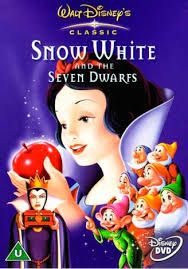
Now, when I talk of something being dark, I talk of it more in the feel of the movie rather than if the movie was poorly lit or used mostly dark colors. Darkness has more to do with frightening images, scary or even terrifying moments in movies, and allusions to the big kahuna, death. The movie I watched recently that really made me start thinking on this subject is actually what is commonly thought of as one of the most pure and innocent children's movies ever made, Walt Disney's Snow White and the Seven Dwarfs; the story of a princess who flees her evil stepmother and finds refuge in the home of seven tiny men, the innocent dwarfs.

When I was watching Snow White, I was amazed at how dark the movie was. I hadn't seen it since I was a child, but as I was sitting there watching it, I could only imagine that if I was watching this G-rated movie as a three-year-old, I'd probably cry in fear. When the Queen transforms into the old hag, that scene is genuinely creepy, and majority of little kids probably wouldn't be able to handle it. In Snow White, Disney portrays the scenes of villainy involving the Queen with a sense of foreboding, nothing comical about her, and same goes for the scenes involving Snow White's death and their somber tone. And while I don't feel that at the end of the day Snow White would be so terrifying for a small child that it couldn't be watched by most children, it just really made start thinking about where to draw the line on what children should, and shouldn't watch.

With a Disney movie, that is a surefire seal of approval for most parents that a movie is certified for children, but sometimes that isn't the case. I just think of Snow White or Sleeping Beauty, and say, you know, perhaps some smaller kids shouldn't watch these just yet. While I grew up watching these Disney movies and stuff like Indiana Jones and Star Wars, that does not mean other children might not find the sight of a man's heart being ripped out as terrifying. While you can say age is the biggest determining factor, there is no one set age as to when something is appropriate for a child to watch and when something isn't, because every child is different. Good example, I was three when I saw Indiana Jones and the Temple of Doom for the first time, and my 23-year-old sister will still not watch it to this very day.

Nightmares in children's movies are common, and usually the only way to know what wont frighten a child is to show them the movie in question, but my advice would be to heed caution. Just cause a movie is rated G doesn't mean it is all right for every child to watch, and just cause a movie is rated PG-13 doesn't mean that your three-year-old can't handle the violence and thrills inherent in the material.

Thursday, September 16, 2010

A Weezerish Hurley


The rock band Weezer is one of the few bands I actually like. Ask anyone who knows me personally, I always care more about listening to movie scores rather than listening to what some would deem "real music". As far as "real music" goes, to me Weezer is the best, and their new album, Hurley, is quite possibly their finest since the '90s. It is Weezer's most complete, most Weezerish sounding, Weezer album since their second, Pinkerton. This is high praise for a Weezer fan, but I think I wasn't the only one who was initially scratching their head at the naming of Weezer's newest album, Hurley. The CD cover art is simply a picture of actor Jorge Garcia, smiling; Garcia most well-known for playing the character Hurley on the hit sci-fi show LOST. So what does this album have to do with the character of Hurley other than his namesake? Simply, the album is a perfect companion to Hurley's character.

The album consists of ten songs, many of the songs having similar themes running through them. Beneath all the lyrics about women, Hurley's songs all bear a message of hope and fighting the establishment. While these songs can be seen as Weezer's journey to rediscover themselves and go back to their roots after departing the corporate label system that had controlled most their albums for the past decade, I think that this journey applies same to Hurley from LOST.

In LOST, Hurley is easily the most lovable character. No one doesn't like Hurley. He is the geek of the island, often not thought of by his fellow castaways as nothing more than the warm, fuzzy big guy, but in the war to save the island, Hurley fights the establishment to rise the ranks and become protector of the island. On Weezer's album, the first song, "Memories," just sounds like something Hurley would love in all his nostalgia, not to mention the final song, "Time Flies". Then songs like "Trainwreck" and "Unspoken" detail how Hurley feels about his constant battle with the cursed numbers that have ruled his life. Even songs like "Smart Girls" can be mirrored in LOST in Hurley's love and relationship with Libby, who is arguably a smart girl. Finally, the songs, such as, "Hang On," display the optimism of Hurley, and, "Brave New World," can be seen as Hurley's theme of being made the new Jacob of the island and the ultimate venturing forth into the after life with the entire crew of Oceanic Flight 815.

Regardless, to say, Weezer is back, but maybe the choice to have Jorge Garcia's mug on the front cover wasn't just a play at randomness? Or maybe I've just grasped at straws.